Monday, January 12, 2026
The State of Enterprise Analytics Broadcasting
From desktop publishing to AI-driven process orchestration
The information delivery process has always been about getting the right information to the right people at the right time, but the means of executing this process have evolved with available technology and the needs of organizations for better governance, risk management and compliance (GRC).
The Evolution of Report Distribution
In the early days of business intelligence (BI), individual BI practitioners used desktop publishing to format the results of their BI queries for consumption by stakeholders in the organization. Pixel-perfect documents built in Crystal Reports were the gold standard for presenting information representing the single version of the truth that BI made possible.
Spurred by the success of BI report publishing, organizations looked for greater efficiency in the process and found it in scheduling. The ability to schedule reports to be generated automatically reduced the need for human intervention - and the potential for human error dramatically. As the need for report scheduling grew, managing schedules became labor-intensive, and organizations looked for ways to lighten this burden. In the BusinessObjects world, they found it in solutions such as APOS InfoScheduler, which allowed them to manage their schedules in the familiar environment of Microsoft Excel, and APOS Instance Manager, which allows administrators to analyze the report instance environment as a whole. Bulk management processes simplified schedule and instance management and, again, reduced the potential for human error.
On-Premise BI & APOS Publisher
As BI reporting became central to the organization's information governance, regulatory compliance, and internal accountability efforts, the need to automate the delivery of reports to the right people at the right time in the right format became paramount. This need led to the introduction of bursting (also known as broadcasting). Data-driven bursting using solutions such as APOS Publisher allowed organizations to organize their information delivery requirements into bursting definitions, which drove scheduling dynamically, and personalized, automated and simplified the bursting process - again reducing the potential for human error.
APOS Publisher also introduced the concept of report distribution orchestration long before the term was fashionable. Its statement generation functionality orchestrated print runs for mail-out account statements from large organizations such as insurance companies.
Cloud-Based Analytics Platforms
The need for timely, personalized, data driven and automated report bursting did not suddenly disappear with the advent of cloud-based analytics platforms. In fact, the need only grew, but these advanced analytics platforms were not built with report bursting in mind. APOS PowerBurst has become a vital lifeline for organizations adopting cloud-based analytics and needing to not only maintain but expand the role of automated report bursting in their analytics.
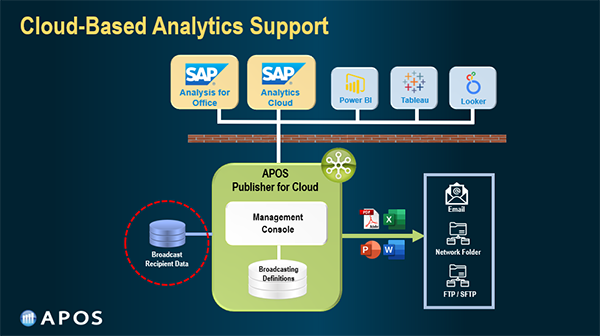
APOS Publisher for Cloud Support for Cloud-Based Analytics Platforms
Learn more about APOS PowerBurst multi-platform support
Cloud-Based Reporting Workflow Orchestration
As organizations expand and automate aspects of their financial, operational and managerial reporting workflows, the need has grown beyond automated report bursting to process orchestration for information delivery. In process orchestration, administrators have complete control over report distribution workflows, from report generation and delivery to failure mitigation, and end-to-end monitoring and auditing. APOS PowerBurst is the first true orchestration solution for report bursting in cloud-based analytics. It:
- Processes reports into personalized information presented at the right time and in the right format
- Provides event-based scheduling of bursting jobs
- Permits monitoring, and auditing of bursting jobs
- Provides automated and manual failure mitigation methods for bursting jobs
- Tracks emails to report recipients and monitors deliveries and opens for greater accountability
Refining Orchestration with Agentic AI
Now APOS PowerBurst's process orchestration capabilities make it the ideal candidate for integration with Agentic AI. The long history that APOS solutions have of reducing the potential for human error now extends to eliminating that potential entirely.
AI is a disruptive technology. It will fundamentally change the way we model our businesses, our workflows, and how we assemble our technology toolsets. Today, organizations are caught between the risks posed by the implementation of disruptive AI technology and the rewards promised in the form of new efficiencies and competitive advantage.
Avoiding risk calls for a top-down approach in which Governance, Risk Management, and Compliance (GRC) take precedence. Guardrails must be erected, risks enumerated, and governance embedded.
At the same time, rapidly establishing valid use cases and workflows is critical to realizing the benefits of Agentic AI, expanding Agentic AI expertise within the enterprise, and understanding the potential of enterprise-wide Agentic AI deployment.
APOS is working with customers on rapid development of specific reporting use cases with APOS PowerBurst that can improve reporting workflow orchestration and reveal the benefits of wider Agentic AI deployment across the enterprise.
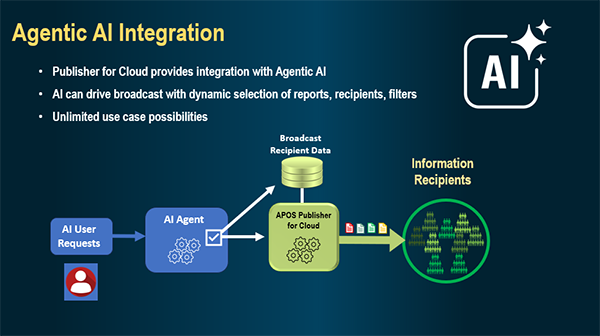
Agentic AI Integration with APOS Publisher for Cloud